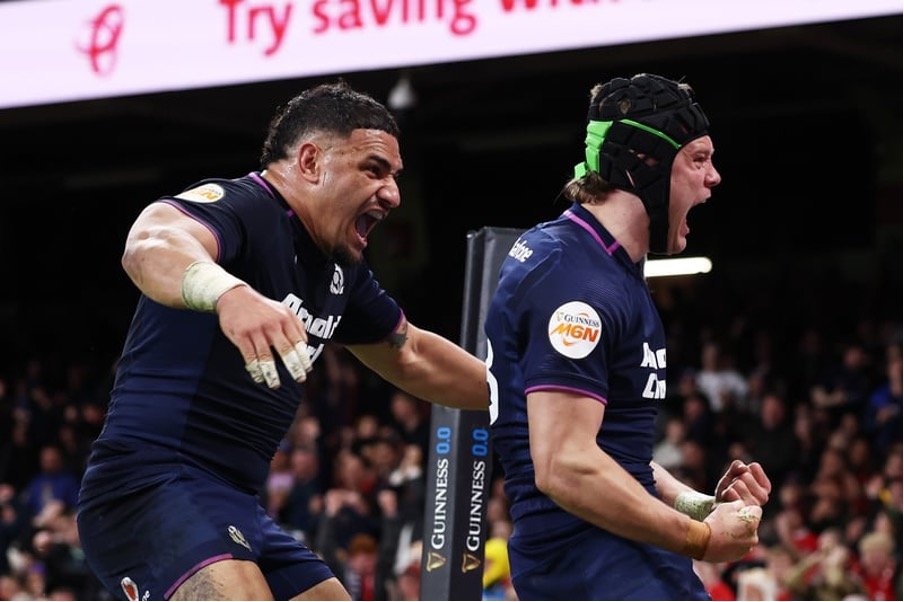
At the Breakdown: Wales v Scotland
By Matthew Parke
Another round of this year’s Six Nations tournament has just wrapped up. England were blown away by a resurgent Ireland at Twickenham, Wales came heartbreakingly close to felling the Scottish, and France had their toughest game of the tournament yet against a spirited Italian team. We are over half-way through the competition now, and the final standings are starting to take shape. It is time to breakdown how each team performed this weekend and how they are shaping up going into the final two rounds.
Wales vs. Scotland
You could feel the energy in this game at the moment of kick-off. Wales looked like they really wanted to play, as the glimpses of quality that occurred briefly in the previous two rounds now turned into longer facets of play, turning this into a competitive contest were most fans may have expected a blowout. Scotland did not play poorly, and had their own adversity to face off the back of such a massive and emotional victory over England; Jack Dempsey, Jamie Ritchie and Jamie Dobie were all casualties of round 2, and the pressure was on to see if Scotland could continue their form going into the next round, or had they once again expended all their energy to topple England.
No disrespect to the Scottish but this Wales side were perhaps eyeing up this fixture as one that they could potential win, especially having so close in the last two years. Alas, despite being in the lead all the way up to the 75th minute, Welsh hearts were broken as George Turner crashed over the try-line, ending the game 26-23 after Russell’s conversation.
Wales started very strong, playing assertive rugby against Scotland who were on the back foot for most of the first half. The contentious decision to start Sam Costelow in favour of the dropped Dan Edwards proved fortunate. Paired with Tomos Williams, they combined to create really structured phase play, an area where Wales have struggled to build at all. He also converted both Welsh tries scored by Rhys Carre and Josh Adams and kicked a penalty, placing wells in the lead 17-5 by halftime.
The Welsh set piece for the most part looked strong. Rhys Carre and Thomas Francis maintained a sturdy scrum to allow the backline to build off in the first half. The Welsh lineout also functioned well as opposed to Scotland’s who only managed and 83% win at lineout time, an area that needs immediate addressing by Townsend and the forward pack.
In the second half is when the tables began to turn. Wales initially scored another penalty to make it 20-5 early into the second half. However, Scotland started to look more solid in their approach, and after 27 phases, Finn Russell would burst through a gap to score, before converting his try to put his team within punching distance (20-12). Costelow also had to be subbed off due to injury after having a brilliant game at 10. Jarrod Evans came on as his replacement. Russell again had another massive impact on the game not long after. Following another converted Wales penalty, Russell took the restart quickly, catching the Welsh napping as they were still getting set and allowing Darcy Graham to score. Russell would also slot the conversion bringing the score line to 23-19. The final score would later come from George Turner off the back of a thundering maul by Scotland to put the visitors ahead and complete the comeback. Wales were still in with a chance following a fumbled Scotland restart, they were given a scrum just outside the Scottish 22. However, their hopes were dashed, as their scrum which had been solid all game, came up second best as replacement hooker Ryan Elias was forced to stand up in the scrum, conceding a crucial penalty. The game ended 26-23 in an agonisingly close contest that surely broke the hearts of Welsh fans.
Nevertheless there are plenty of positives to take from this match from the Welsh perspective. The Welsh defence was far better than previous rounds. Wales boasted a 90% tackle completion rate than compared to England (86%) and France (81%). This becomes more impressive when you consider Scotland have arguably the second best backline in the whole competition. Wales managed to front up for most of the game rather than being blown apart as they have previously, a great sign and confidence booster for this young squad to build upon. The locks, Dafydd Jenkins and Ben Carter put in two monstrous performances in defence, with 24 and 22 tackles each, and going down the stat sheet they are not the only ones who put in massive defensive shifts; Aaron Wainwright (18), Alex Mann (17 (also credited with 2 turnovers)), James Botham (15), Nicky Smith and Archie Griffin (12 each). For Wales to continue to build, defence is the first thing they need to sort out considering previous whitewashes not in their favour. The maintaining of this level is paramount to that.
Top players such as Aaron Wainwright and Dewi Lake also made big impact carries. Costelow despite his injury is a great option at fly-half for Wales, alongside Dan Edwards. What let Wales down is discipline. This has been a persistent issue for this Welsh side. In crucial moments of the game they concede penalties; Tomos Williams’ croc roll on Rory Darge reversed a penalty near the Scottish posts, and if converted would have put Wales 7 points clear; Wales gave away 3 penalties that ultimately led to the kick to the corner and maul which led to Turner’s game-winning try; the scrum gave away a penalty under immense pressure in the 77th minute in Scotland’s half. Despite an outstanding effort, a lack of discipline ultimately allowed Scotland back into the game in the dying moments were every decision matters. The performance was definitely a massive step up, but against Ireland and Italy, they cannot afford that level of ill-discipline. The next two fixtures are going to be massive challenges for Wales. Ireland look strong after beating a poor England side that but 49 points on Wales just two weeks ago, and Italy are building with every performance and have an impressive record in recent history over Wales. Players have stood up, the defence has tighten, but at this level, marginal errors can cost you games.
Scotland showed a lot of determination in the face of adversity. Off the back of their victory over England, they showed how they could play and break teams down. They didn’t start the best and had to go to their bench early but players like Bayliss, Horne and Graham played excellently when they came on. Of course, this Scotland team is completely hinged on Finn Russell’s performance. When he is at his peak they look unbeatable. He really stepped up in the second half and ended up being a difference maker in the game. Blair Kinghorn, Sione Tuipolutu, Huw Jones also all had decent showings, whilst man of the match winner, Rory Darge was a constant jackal threat. In previous years, Scotland might have dropped off in games like this. An annual criticism aimed Townsend’s Scotland is that they seem content enough to just beat England every year but don’t accomplish much else aside from that. Although they have beaten Wales for 4 consecutive years now, this performance showed real grit from Scotland against a Welsh side that really had belief in their ability. They maintained their composure and brought real energy when so far behind in the second half. France away is a daunting task. A battle between the two best backlines in the competition, yet Scotland cannot afford to start slow against the French who have knack for not slowing down at any point across an entire 80 minutes. Ireland at home next will be a tough. If Ireland are given chances by Scotland it could be a long day at Murrayfield. Tadhg Beirne and co. will particularly be targeting the malfunctioning Scottish lineout, with the rest of the pack gunning for Russell. The pressure is still firmly on Gregor Townsend to deliver to the Scottish fans. These next two weeks are crucial in preparation for Scotland’s next two fixtures.